White Boat sails to a conclusion, with a grim view of humanity

An advanced review of the Scott Snyder and Francesco Francavilla DSTLRY series. Plus more inside!


Share
White Boat sails to a conclusion, with a grim view of humanity
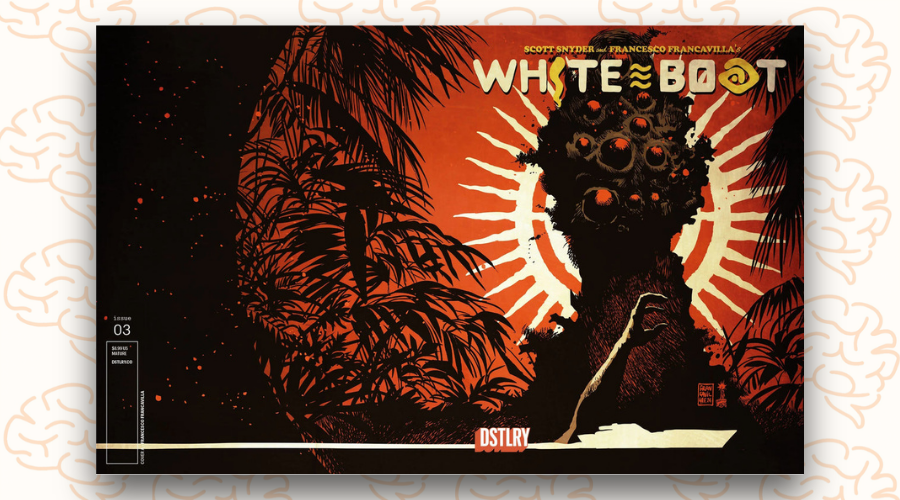
White Boat #3 via DSTLRY

Welcome to our third comics newsletter! This week we have an advanced review of the long overdue DSTLRY series White Boat (written by both Jamie and Tom), including some preview pages of its final issue. Plus, Robot Monk, and a deeper "Thematically Snyder" piece.

A cautionary tale about humanity's most toxic ancient bioscience startup

White Boat is a spooky three-part story offering a critique on human nature and all the twisted ways grief and guilt can impact the trajectory of life. Told through the perspective of a nautical journalist, who receives an exclusive invitation to a mysterious super yacht worth $3 billon that's said to grant its passengers' every desire. Though once aboard, you actually get trapped in a limbo hellscape while being transported to a secret island where scientists study how to unlock all of humanity's potential.

What we loved about this series is that it wasn't what you expect upon opening it, not from the description alone. Maybe from the glorious Lovecraftian elements, which really hit their mark without being too distracting. But otherwise, we get a story that always feels grounded in reality, with main passenger Lee Darry serving as an anchor to lots of very fringe scientific concepts and impossibilities. It also wisely doesn't dwell too much on bioscience, instead treating it more as human-engineered mysticism and horror. Even so, I'd have liked to see at least as much attention to gene-editing as maritime science explanations – given what the overall story leads us to.

Telling a story about a journalist is a good way to get comics media immediately interested in the book. But also unnecessary if it's written by Scott Snyder, (he of Absolute Batman acclaim, lowkey messiah of new comic audiences). Or you can tap artist Francesco Francavilla, whose illustration of eyes throughout the series pierced through my soul. They imprinted a memory upon my brain the way staring at a lightbulb impacts your vision. And, it's probably the biggest reason you should pick this series up.

Photograph of comic series White Boat shown on a large TV screen and in print on a table.
Comics branching across mediums. Photo by Tom Cheredar

Though it's worth noting that both of us consumed White Boat very differently. Jamie bounced between an iPad and a monitor screen, whereas Tom alternated between the gorgeous 48-page printed editions (#1 & #2) and casting the PDF review files to his 55'' OLED TV.

You can pick up a free digital copy of White Boat #1 via Neon Ichiban, so no excuse not to check it out. The third and final issue is scheduled to hit digital and comic shop shelves July 8, (print pre-orders end 5/18, fyi).

Until then, check out some preview pages from the conclusion below.


Photo and Robot Monk origin pages by Josh Boulet

Spotlight: Joshua Boulet's Robot Monk Comic

Robot Monk is a beautifully illustrated sequential story that begins with a bunch of wealthy fat cats who have decided to purchase a valuable, secluded island. The only wrinkle in their plans? An ancient order of monks who preside over the land, routinely engaging in a fire ritual supposedly intended to preserve the earth and its inhabitants. When the business men sick their semi-organic humanoid autonomous robots (Bio-Boys) on the monks, it disrupts the ritual and leads to the origin story of our robotic hero.

Two specific scenes really resonated with me about this comic. The first happens in the origin reveal (see photo above) in which Robot Monk's swords are given the names "Truth" and "Enlightenment," followed by an excellent use of sound (Z-CRACK; TAP, TAP, TAP, TAP, TASKIT!). The second happens toward the end, where the robot is about to fall on its sword before realizing a greater purpose. It's a solid introduction, and one that already has a second issue planned and funded via Kickstarter.

Creator Joshua Boulet's work features clean lines and straightforward panels with plenty of detail^*.What I love most about this debut issue is the wider magazine size, and the fact that he's got command of what a black and white story must be to pass muster in this era of comics. If you enjoy Kung Fu books as much as I do, but with the familiar vibe of early Teenage Mutant Ninja Turtles comics, Robot Monk #1 will not disappoint.

And neither does Boulet, whose other work is definitely on my short list of things to check out.

Check out the full article this Sunday, featuring a short Q&A with the creator.


Thematically Snyder: Clear, Wildfire, White Boat

(By Jamie) – In reading White Boat, it dawned on me that it felt familiar. On further reflection, it completes a trilogy of graphic novels in which Scott Snyder uses different genres to explore certain common themes, with the help of some supremely talented artists.

In 2021, Snyder teamed with Francis Manupal on a cyberpunk noir story titled Clear, a Comixology Original that was later serialized and collected in print by Dark Horse Comics. Clear takes place in a not-distant-enough future where virtually everyone uses neurological filters to see the world as they want. They can apply global “skins” that make the world look like their favorite movie or historical time period, all while blinding them to the existence of the less fortunate.

Virtually everyone uses this technology except for protagonist Sam Dunes. Dunes lost his son in an accident caused, at least in part, by the blinders everyone chooses to wear, the bubbles everyone chooses to create. And so he lives “clear,” without filters, as one of the few who sees the world as it actually is.

Manupal is likely best known for the sharp, glossy, and modern look he brought to superhero comics, primarily DC’s The Flash. It should have been obvious earlier that he’d be the perfect artist to imagine a modern, techno-chic version of a cyberpunk future. Manupal perfectly realizes this future at the intersection of smart glasses and the AI bubble.

But the personal story at the core of Clear is what starts the thread that leads to White Boat. Dunes is haunted by his past, specifically the loss of his family, and it’s only when he’s challenged to face his past rather than be haunted by it that his character moves forward.

It’s similar to a theme in Dark Spaces: Wildfire, the 2022 IDW Publishing series Snyder wrote that also first exposed me to the revelatory work of artist Hayden Sherman. Nobody could have been a better choice for a series that, visually, relies on both the beauty and terror of nature and the weathered emotions of characters who have been through it for a long time.

The story is about a team of firefighters from an all-women correctional facility who battle wildfires. As one might expect of a story about convicts, they’ve all got a past with some unfortunate turns. That includes the officer in charge of chaperoning them.

But when the opportunity to take from an abandoned cabin owned by the wealthy presents itself, they’ve all got to face their history and decide how long they’re willing to keep paying for it, and what they’re willing to do to escape it.

The existence of this supposedly loaded cabin leads to another theme that unites Clear, Wildfire, and White Boat: the stratification of society along economic classes. But these aren’t stories where the hero saves the world by changing it. That’s beyond their scope. These are more intimate tales about characters making peace with themselves and their pasts in a world where justice and forgiveness are fleetingly rare.

White Boat makes these themes more literal than the other two volumes in what I’ve decided is a thematic trilogy. Perhaps that’s why it rings a bit differently than the first two series. But the message shared by all three – or at least one message that can be taken from them – remains consistent: make peace with yourself, and don't trust rich people.