Where Did All The Humans Go? A Story of Robots and Social Media Refugees
SXSW used to be the conference social media brands launched at but is now where they go to die. Case in point: I threw a wake for Digg.

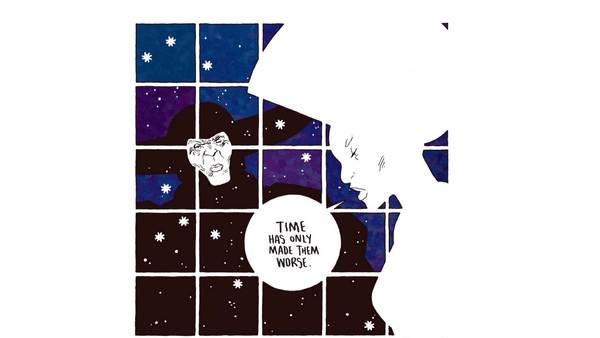
FYI - Don't miss our original comic inspired by reality: Social Media Funeral
SXSW used to be the conference social media brands launched at but is now where they go to die. Case in point: I threw a wake for Digg at SXSW.
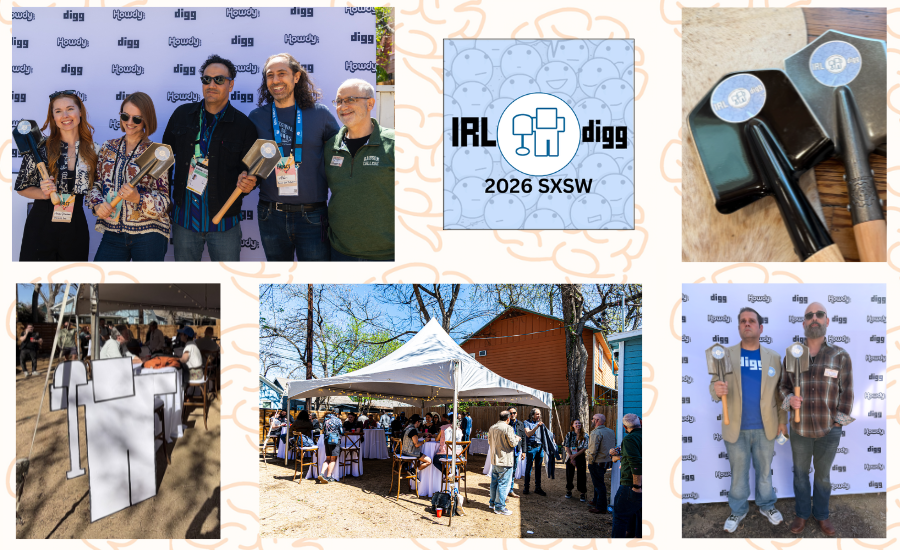
Except at the time I didn’t realize it was a wake, and neither did the 100 or so folks who showed up for the first community-led IRL Digg meetup. There was free booze, a giant cardboard Digg mascot, a step & repeat backdrop, tactical shovel photo props, and more. I designed (and purchased) way too many IRL sticker badges that were going to also show up on Digg profiles. Folks inside Digg had reached out to help me organize and spread the word, and I even found a sponsor (howdy Howdy!) equally nostalgic about that entire period of social web. The majority of attendees were Austin-based, both new users and OGs like Brian Brushwood of Scam School. Nearly everyone knew of the platform’s past, and were excited about its potential in comparison to every other major social network. The ideals it represented were enough to formulate the beginnings of a new community, even before the technology stepped up its usefulness. Honestly it was a great party, and everyone was already asking about the next one.
For the uninitiated, Digg is the pioneering community news site founded by Kevin Rose in 2004 that once rivaled Reddit as the internet's front page before a disastrous 2010 redesign drove its users away. Rose (along with former rival Reddit co-founder Alexis Ohanian) acquired the brand in March 2025 with an ambitious pitch: a human-centered community platform that would use AI to fight the bot infestation plaguing modern social media, restoring the authentic, user-driven discovery that defined the early web.
Things did not go as planned.
Exactly 24 hours after the IRL meetup, Digg announced it was abruptly shutting down – just two months after its public launch.
Digg’s Cylon moment + Verifying humanity requires humans
For a brand famously known for marginalizing its passionate user base the first time around, this is not the way I would have expected the 2026 iteration to wind down. There’s been a lot of curiosity about what happened and why so suddenly. When did they decide to kill it? Who made the final call? The short answer to all of those is I don’t know. I’m told the “decision was made” a few days before the meetup (which means they could have given me a heads up, but I’m not upset to have avoided birthday-turned-funeral party energy.)
The official word from CEO Justin Mezzell is that the public beta quickly got overwhelmed by malicious bots, aka sophisticated AI agents and automated accounts. This lines up with increased interest in OpenClaw tech in late January. But the fatal flaw in the company’s strategy? An inability to distinguish humans on the platform.
Without frictionless methods of human verification, other large social networks could soon meet a similar fate. Or at least that’s the current refrain among tech industry folks. Human verification isn’t difficult, it's just not profitable for social networks designed to scale. The relaunched company first asked roughly 23,000 total users to join a white label community platform hosted on Circle.so that required a $5 initial fee as a form of human verification. (It later donated that money to a charity).
That’s not a knock against what Digg employees built. I largely had a positive experience with Digg and its team. But it is also possible humans just aren’t showing up on social media, which has been obscured by sophisticated human-like bot activity, until recently. It could have also been a factor in Digg’s demise, according to traffic data about the platform compiled by former Digg users. Some informally estimated just 20k average active users before the reset. Also, Digg saw over 105k signups, but as few as 5,649 users who authored a post or commented in the two months after going public.
“The reboot of Digg has basically failed,” remarked power user and TechMeme Editor Emil Protalinski on news of the “hard reset.” Emil was responsible for submitting more posts to Digg than any other user by a wide margin, (accruing more than 69,000 'Diggs'!). And not just internet point spamming, but relevant, interesting, and thoughtful submissions. “Honestly, I think Digg 2.0 shut down too soon. It was odd how quickly they threw in the towel,” he later told me.
Digg’s shut down was quickly overshadowed by news of Meta closing its $77B bet that people actually wanted a VR social network championed by real human Mark Zuckerberg. Then OpenAI decided it’s killing Sora, which was far easier than giving partners like Disney $1 billion in fees based on usage of real humans mixing its IP with the AI generated content tools (I’m assuming). And finally, Reddit now thinks it might have a problem with bots that would force it to start verifying its users.
The market still seems frothy for a social media competitor that behaves and remains transparent about how it uses AI. But where do the humans go in the meantime?
What’s next? Digg refugees are organizing, vibing.
There’s an even bigger question of whether people will even want to come back for the next version, which is tentatively in the works. Details are scarce, but Kevin Rose has proclaimed nostalgic Digg is dead. I understand what he means (and agree, largely) in regard to the tech. But Digg at this point is pure nostalgia. It's basically a franchise restaurant. When and if it comes back, it will be for the same reasons people chose Taco Bell over a nameless food truck. The latest iteration, di.gg, doesn't even include community or voting – but still uses the brand.

Many users I’ve spoken to are at least a little upset. However, not everyone is angry. Some are sympathetic, given the pace at which dead internet theory is becoming reality. Others are banding together to build their own community sharing platforms. The Sharp Shovel Society was a group of Digg’s most active users collected within an internal company Slack channel. When news of the hard reset dropped, most of its members took refuge within a Signal chat room (appropriately named DiggHaven). Its members include business leaders, software engineers, university and college professors, as well as plenty of folks from all over the world who just like to tinker and build. The goal? Organizing into a collective voice and bringing its contributions, energy, and enthusiasm to other social platforms.
The centralized theme among DiggHaven conversations is a lot of ideation for what the next iteration should possess. One topic that keeps getting cycled through discussion is the IRL Digg meetup and the idea of human connection.
“What if instead of building something around hobbies, you focused on cities and more specifically building communities within your IRL community?,” said Adam Gaweda (aka tsumnia), a NC State University professor specializing in AI who has used every iteration of the platform. Given how indefinitely online our lives are, he makes a pretty good point. “Maybe it should be Digg: Find Your Reason to Get Off The Internet.”
In the month since Digg’s hard reset, Sharp Shovel members have started to build three other platforms, each in their own niche, attempting to scratch the itch. On the technical side, we’re seeing a leveling of skills and capabilities thanks to vibe coding that could theoretically produce a slew of viable competitors. The farthest along of these platforms is Hivemind, a hyper-local platform built around physical proximity and external anonymity rather than ego and self promotion, according to creator Jeff Caldwell (aka comdak). It doesn’t have user profiles, algorithms, or care about what's happening on the other side of the world… It's about what real people are doing around you in your community. Hivemind is built using a comparable tech stack (to Digg), but the platform is already far more feature rich than its inspiration. The others, SocialVoid and TavernTalk, are still coming along.
Outside of these projects, the group is really just a lot of tinkering among a few verifiably verified humans who managed to connect before the robot hordes invaded. My takeaway from this experience is that we can no longer rely on huge platforms to help us find our people, but the tools are now available to make it happen for ourselves.
Once upon a time, I threw a huge IRL Digg party at SXSW for a hundred people who didn’t need a Digg platform to find connections or verify their humanity.