Dredd Comes To America
2000 AD is now available weekly in America, making Judge Dredd more relevant than ever.

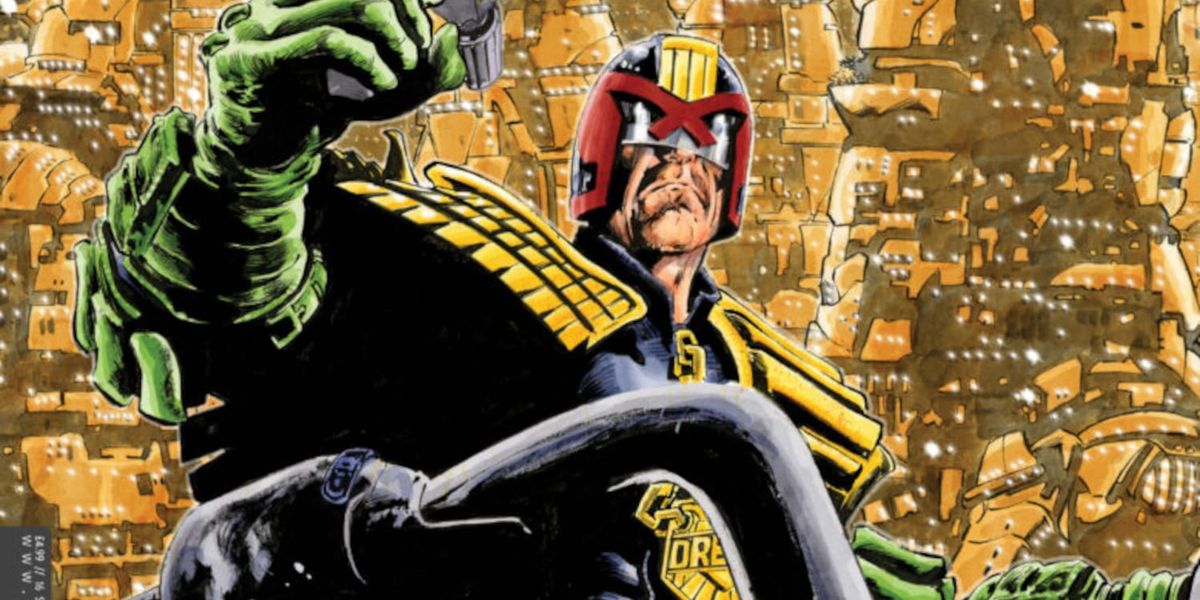
One of the most enduring characters in comics history is finally bringing justice to American readers weekly.
Since 1977, 2000 AD has been a cornerstone of British comics. An anthology of sci-fi, fantasy, and horror comics, it has published stories by many of the U.K.'s greatest comics creators, including Alan Moore, Dave Gibbons, Grant Morrison, Brian Bolland, and Garth Ennis. It still does today, having published stories by recent breakouts Si Spurrier, Al Ewing, and others. Thanks to these creators, 2000 AD has a reputation for telling speculative fiction stories with a bit more boldness and edge than is typical of mainstream American comics.
"Each issue of 2000 AD has several different stories in it, all set in different worlds and featuring strange and unexpected characters," 2000 AD marketing manager Steve Morris tells Weird City. "No other mainstream publisher would want to touch these sorts of subjects, but at 2000 AD we’re committed to being socially relevant, to telling these stories which need to be told and put fire in your heart."
He continues, "Imagine a long-running comic publisher like Marvel or DC which has millions of characters – but can end stories; kill off the heroes; have an unhappy ending or hit harder political truths without fear of upsetting the board of investors. That’s what 2000 AD is. It’s mad and independent, and it champions the power of the working class above the ruling powers that try to hold us back."
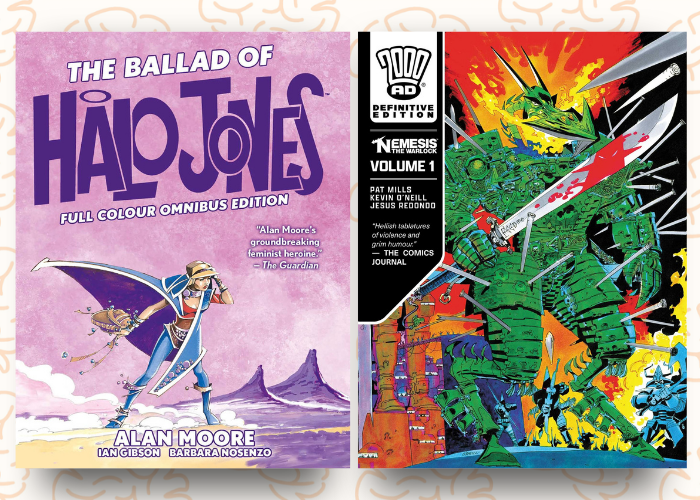
Moore and Gibbons' The Ballad of Halo Jones is a great example, being the story of a poor teenage girl who dreams of leaving the housing-estate-in-space where she lived and ends up manipulated into fighting in a Vietnam-like interstellar war. Another is Pat Mills and Kevin O'Neill's Nemesis the Warlock, following the title character, a demonic-looking so-called terrorist fighting against the tyranny of the fantastical Terran Empire and its Grand Master, Torquemada.

Enter Dredd
But one might not get this impression from 2000 AD at first glance. That's because the magazine's most popular, recognizable, and enduring character is Judge Dredd, in many ways an agent of those "ruling powers." Created by John Wagner and Carlos Ezquerra in 1977, Dredd is the face of policing without mercy in a dystopian sci-fi future, now with nearly 50 years of history.
While Judge Dredd is a British invention, he's also an American "hero." The very first Judge Dredd story is set in "New York 2099AD." Two issues later, a clarifying retcon revealed that New York in this era is a part of Mega-City One, a megalopolis covering nearly the entire Eastern United States, with most of the rest of the North American continent rendered a radioactive wasteland by international conflict.
If Mega-City One represents a bleak vision of where the United States may be headed, then its Judges are the future of American law enforcement. Wagner, Ezquerra, and the many other creators who have contributed to Dredd's mythology over his five decades of service have typically used the character and his world to satirize both American and British culture, and especially police brutality and overpolicing.
What has made Dredd so enduring is the complexity beneath what appears, on the surface, to be a one-note character – easily dismissed as a sci-fi Dirty Harry. And there's certainly an element of that in many Dredd stories.
But Dredd remains compelling because he's a true believer. He enforces the law ruthlessly because he believes that's the best thing for the city and its citizens, at least those who abide by the law. He applies the law and its punishment to everyone regardless of class or status: rich or poor, judge or career criminal; if you break a law, you can expect to do "cube time," and if you resist arrest, you can expect ot find yourself looking at the wrong end of Dredd's high-tech "Lawgiver" pistol. That's more than can be said for some of his peers in Mega-City One's Justice Department.
This has allowed writers to cast Dredd in different roles depending on the needs and goals of the story at hand. In one story, he might be the bogeyman, the avatar of an unjust and uncaring system. In others, he may be the hero fighting against corrupt individuals within the system he represents.
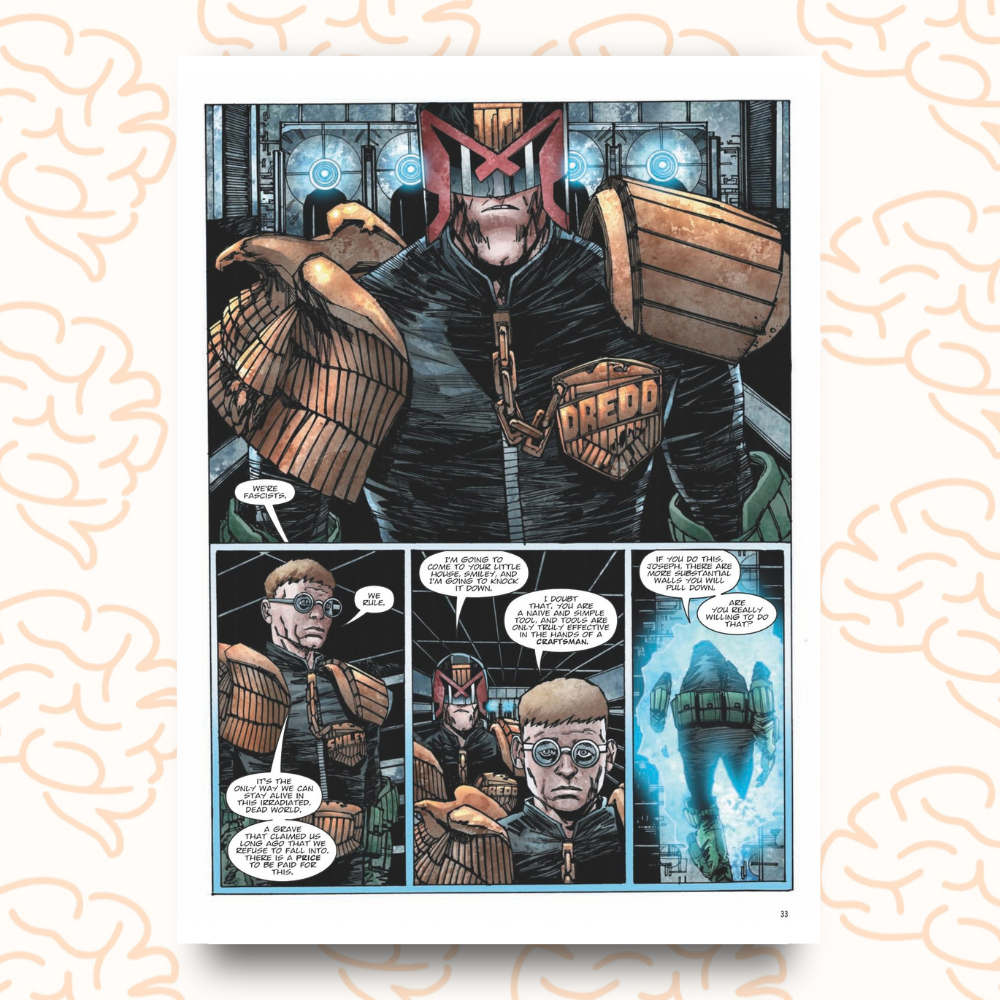
Perhaps the best recent example of this is "The Small House," Rob Williams and Henry Flint's story about Dredd confronting Judge Smiley, the leader of the Justice Department's Black Ops Division, whom Dredd felt had far overstepped his authority. In one meeting between the two, Smiley reminds Dredd, point blank, "We're fascists. We Rule," laying bare the tense and captivating dichotomy of Dredd being, if not a good man, then at least a fair man working for a brutal, totalitarian regime.
"I think we knew we had something special on our hands the moment we started seeing Henry’s art come in, and we got some real-time feedback when it started running weekly in 2000 AD."
– Arthur Wyatt, cowriter of A Better World