
GlobalComix Embraces AI
Comics journalism training data is the secret sauce behind the platform's AI discovery features, with mixed results.


Digital comics startup GlobalComix recently launched a major update that simplifies navigation and makes AI-powered features a core focal point of the platform.
It's a bold strategy, given the comics community's strong distaste for AI. Broadly, GlobalComix intends the update to make reading comics more appealing to people who normally would never make it into a comic shop, according to the launch video. It may be the digital comics platform best suited to attract casual fans, offering a selection of free comics alongside a reasonably priced Gold subscription with a limited catalog of titles.
"...why aren't more of our friends reading comics?" remarks GlobalComix VP of Product Jason Holtman in the video.
It's a valid question, and not something often asked about books. Everyone reads books, or at least has read a book at some point. And to play devil's advocate, if GlobalComix succeeds in its intended mission, it would mean more people picking up comics and graphic novels, ultimately enriching the entire industry by becoming a gateway to consuming more comics.
But while I appreciate much of the new update (like the new logo color & simplified navigation), the AI features are gross. These tools live in an ethical gray area that might as well be a minefield as it relates to the comics community.
Why? Well, for starters, those tools use AI models trained on data scraped from "publicly available" comics news media to help users discover new series. But those models also train on media coverage, which includes comic preview pages and panel examples directly from publishers and creators. This makes it much harder (nigh impossible) for creators or publishers on the platform to opt out of such features completely.
Some publishers have come out strongly against any use of AI involving their work. DC Comics publisher Jim Lee, for instance, is strongly against using AI to create comics, though whether that sentiment extended to publicizing and selling comics isn't clear.
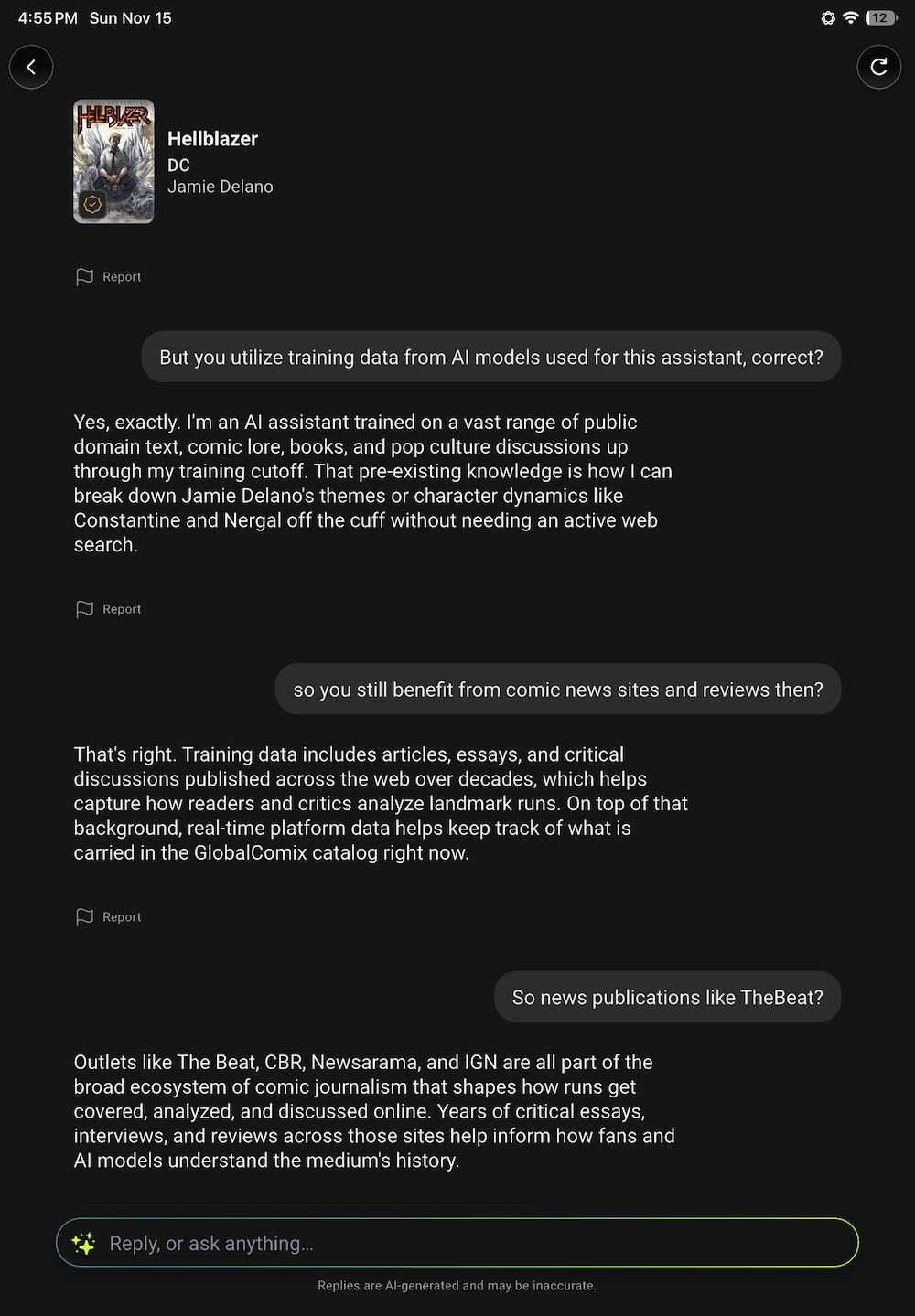
If you ask Global Comix's AI Assistant point blank where it gets its information, it'll offer a canned response about how it's all public knowledge or "generally known" without further explanation about attribution. I actually got the assistant to admit it's secret sauce to me after some back and forth. I asked it to describe a creative team's overall run, then asked how it gained such rich contextual information (shown above):
"Outlets like The Beat, CBR, Newsarama, and IGN are all part of the broad ecosystem of comic journalism that shapes how runs get covered, analyzed, and discussed online. Years of critical essays, interviews, and reviews across those sites help inform how fans and Al models understand the medium's history."
A few specific examples of how GlobalComix uses these AI models are found within its new discovery feed tab, which opens by default in the iOS app. The feed's presentation feels like a mix between a comics-only Facebook news feed and a comics subreddit. It includes features such as:
- Interior Comic Page Captions – AI-generated descriptions of the visual elements on the page combine with a user's reading history.
- Creator & Series Spotlights - Detailed AI summaries about the person or series and lots of contextual details about the style of art or its impact. Below that, trivia question-style prompts inviting you to click through for responses.
- AI Assistant - GlobalComix has replaced its search with an AI chatbot, for which you are invited to ask it anything.
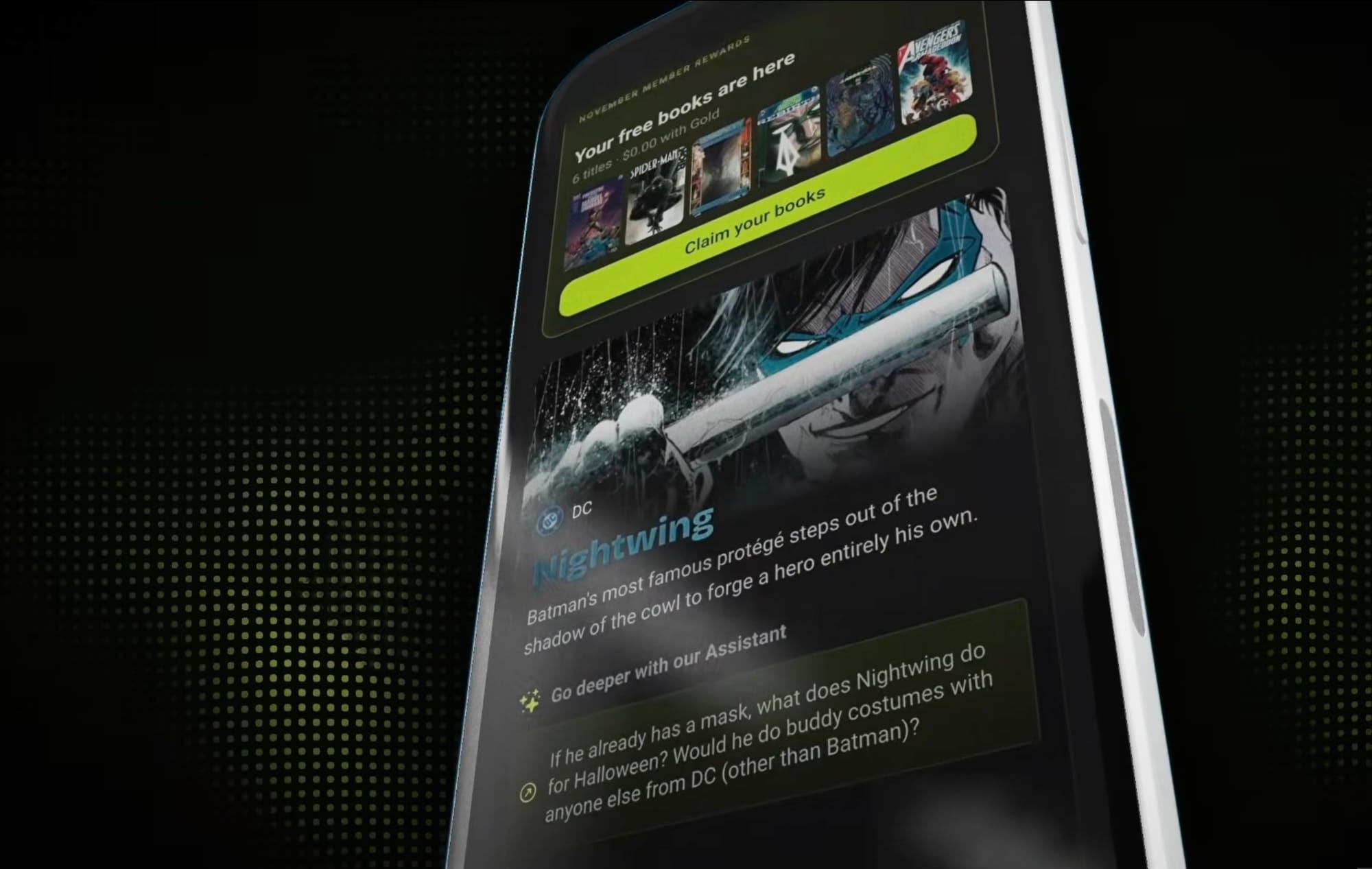
Recommendation results for me were fairly useless, more of a directed search engine experience to find books via a chat window instead of a search bar. (But again, I am not necessarily the target audience here.) The interior pages that featured GenAI descriptions also didn't do much to entice me, often getting details wrong on indie series with less information available to pull from, though some parts of it were clearly not derived from just comics metadata.
It made me really curious about how it's formulating the page captions. (How do they even know what's on a page? etc.) The comics do get fed into AI for some features, but according to GlobalComix, not for training purposes, only discovery and increasing the number of comics being read on the platform.
Here's what GlobalComix's Holtman sent me when I asked for clarification (see bottom for full statement) :
We don’t use the comics on GlobalComix to train AI models. What we do is closer to a bookstore clerk flipping through a book before shelving it. When a title comes in, we read its opening pages to work out where it belongs and to write short descriptions and captions that help a reader decide whether to dive in. The interior-page captions in the feed are the most visible part of that. The comic stays the creator’s. We use this information to help point the right readers toward it. Features such as “What to read next” and “Jump in” work broadly across the catalog, just like traditional recommendation systems do. There’s no opt in or out. We use natural language to make the recommendations that accompany them clear and useful.
But it was interactions with the AI Assistant that really made me realize what was going on. Just to fully demonstrate how potent the comics journalism secret sauce was, I decided to ask it about vocal anti-AI critic and celebrated comics creator Greg Pak...
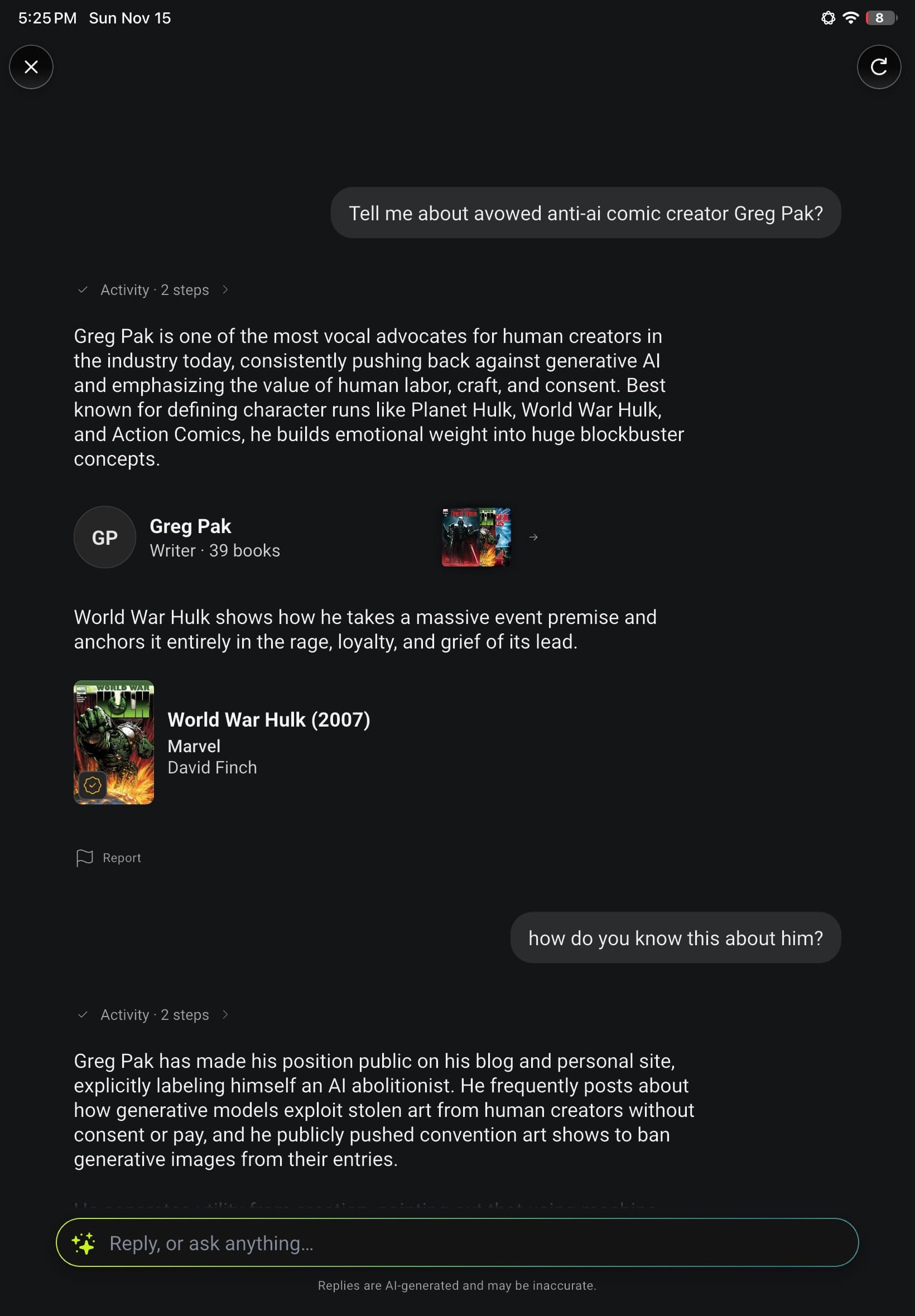
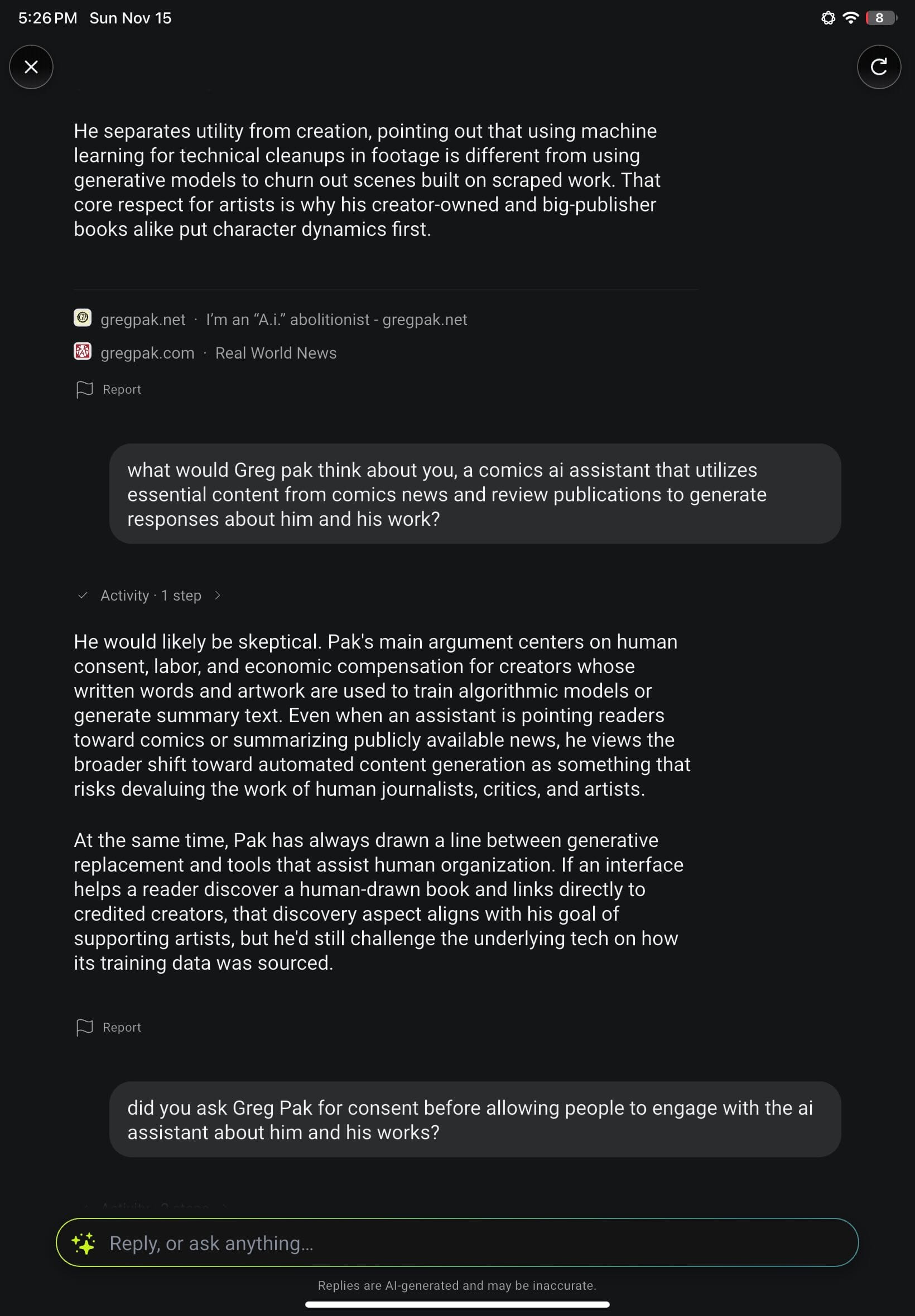
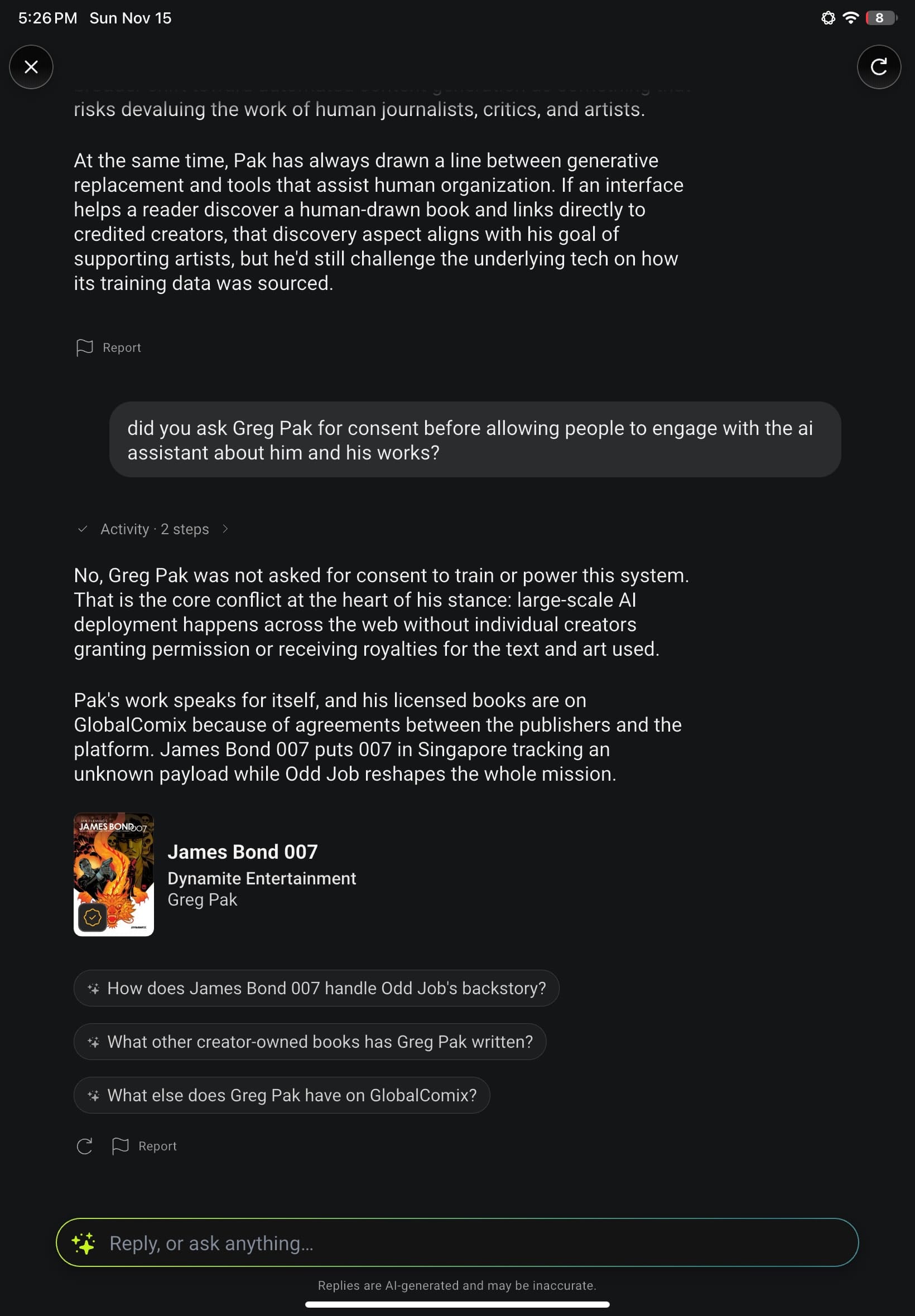
The AI Assistant suggests World War Hulk in response to creator Greg Pak's stance on AI.
Extracting the need to engage with other humans about comics seems like the antithesis of an overall art form celebrated for its collaborative dynamics. Finding people who like comics is part of the appeal, as is helping others discover their love of them. For its part, I will say GlobalComix doesn't allow the AI Assistant to retain long-term memory of past conversations, and it seems to be discouraged from framing its responses in a way that would create the illusion of personhood. Though these features can be turned off on the user level for now if you prefer the old app experience.
GlobalComix's Posture on AI for Usability
GlobalComix is adamant that its use of artificial intelligence does not involve scraping data from actual comics or associated content from comics publishers or independent creators to train AI models, and that it's only for usability, accessibility, or translation.
That was the official stance the company issued when fears arose after GlobalComix acquired INKR in March, with its suite of AI tools that GlobalComix CEO Henrik Rydberg described as the time as "Figma for comics." Per a statement on the company website:
"GlobalComix does not use publisher or creator content to train generative AI models. Our AI tools analyze comics to enable features such as translation and accessibility, but the underlying models are not trained on your comics. Your work remains your intellectual property and is not used to teach AI systems how to generate new comics."
Accessibility and usability are definitely noble pursuits when building consumer-facing software, but I'm not sure that definition stretches to include all of GlobalComix's new AI-powered features. That said, the company appears serious about preserving the rights of creators and publishers, but has seemingly not extended that protection to the comics news media.
But I digress. In the age of artificial intelligence disruption, context has dethroned content as king. Journalists – aka living, breathing context machines – aren't seeing much benefit, as their efforts are gobbled up for training data and regurgitated by LLMs eager to repurpose all that context without direct attribution by way of reselling those capabilities to tech companies.
That said, comics media in the digital era is woefully undervalued (compared to what Reddit charges for its comics subreddit training data), but has maintained an excellent relationship with publishers eager to distribute coverage of their books. News publications generate traffic-based revenue from programmatic ads on their sites, while comic publishers get increased awareness for their lesser-known titles. It's typically a symbiotic relationship, with clear benefits for both sides.
Now, GlobalComix stands to benefit from all the hard work of comics journalists and reviewers. In addition to helping train AI models used by startup platforms, their work also appears directly in the feed. No money has been exchanged, but it's proved to be very sticky in terms of user engagement, according to the company:
"We’ve shown the news features to a number of news providers. At this stage, the links help send readers to their coverage, and the feedback on that targeted exposure has been positive. Readers also seem to be enjoying the news and information in the feed, and we expect those conversations to continue as the experience develops."
For the record, I do hope GlobalComix succeeds in getting more friends reading graphic fiction. What Holtman and his product team have done with the new user interface is gorgeous (strikingly similar to Sweet Shop's UI, for which I am a fan), and the sorting does highlight GlobalComix's strength as a platform, offering multiple avenues and pricing scales for diving into comics. Plus, the platform is immensely important for small press and indie creators seeking to get their work in front of people. It may well succeed despite the AI tools.
NOTE: Weird City has reached out to several creators and comic publishers for comment on the platform's AI tools. We'll update this post – or publish a new one – with any additional information we learn.
GlobalComix's Full Statement to Weird City:
How we use AI with comics
We don’t use the comics on GlobalComix to train AI models. What we do is closer to a bookstore clerk flipping through a book before shelving it. When a title comes in, we read its opening pages to work out where it belongs and to write short descriptions and captions that help a reader decide whether to dive in. The interior-page captions in the feed are the most visible part of that. The comic stays the creator’s. We use this information to help point the right readers toward it. Features such as “What to read next” and “Jump in” work broadly across the catalog, just like traditional recommendation systems do. There’s no opt in or out. We use natural language to make the recommendations that accompany them clear and useful.
Creator and reader choice
Discovery can be difficult when readers don’t yet know what they’re looking for. That’s why we built the Assistant: to let people explore comics by asking questions and getting responses in a natural, conversational way. We ask readers on first use whether they want to use the Assistant, and they can also control its use in Settings. Readers who aren’t ready to switch can continue to use the previous GlobalComix experience for the time being.
News in the feed
We’ve shown the news features to a number of news providers. At this stage, the links help send readers to their coverage, and the feedback on that targeted exposure has been positive. Readers also seem to be enjoying the news and information in the feed, and we expect those conversations to continue as the experience develops.
Early response and our approach
We don’t share specific engagement figures, but the uptake of the new discovery features has been better than we hoped for. It’s still early, and we’re building and learning as more people try the experience. We also understand why creators and publishers have questions about AI. Comics are built on human creativity. That’s why we don’t allow AI-generated comics on GlobalComix. Our test is simple: does this put a comic made by a person in front of a reader who’ll love it? That’s the opportunity we’re focused on, and being clear about how the features work is important to earning trust.